Wednesday, September 14, 2011

160 million year fossil...

A five-year-old girl in Britain has found a massive 160 million-year-old fossil while digging with her plastic beach spade. Emily Baldry found the pre-historic specimen at Cotswold Water Park in Gloucestershire, Daily Express reported on Friday. She was digging when her plastic spade struck something hard.

Her father Jon and palaeontologist Neville Hollingworth helped Emily dig it out and were left amazed to find a rare fossil. It was of a mollusc that lived in the oceans in the Jurassic period. "She (Emily) is a very inquisitive little girl and got very excited about going on a proper dig. To find something like this was very special," Jon was quoted as saying. Palaeontologist Hollingworth said: "I have been looking for these for around 25 years and only found three."


Fosil 160 Juta Tahun


TAMAN AIR COTSWOLD, Britain - Seorang budak berusia lima tahun, Emily Baldry menemui fosil cangkerang berusia lebih 160 juta tahun selepas menggali tanah dengan menggunakan sebatang penyodok yang selalu digunakan untuk membina istana pasir, lapor sebuah akhbar semalam.

Emily menemui fosil seberat 57 kilogram itu yang jarang didapati itu di kawasan Taman Air Cotswold di sini dengan bantuan bapanya Jon, 40, pada Mac tahun lalu.

Fosil lengkap berdiameter hampir 40.6 sentimeter itu berasal daripada haiwan moluska yang mempunyai cangkerang yang hidup di lautan.


Ia kini disimpan di kediaman keluarga berkenaan di sini setelah ia dipamerkan kepada umum. Cangkerang itu diberi nama Spike oleh Emily.

Selepas cangkerang itu ditemui, dia menyerahkannya kepada seorang ahli geologi, Neville Hollingworth untuk dibersihkan.

Emily yang kini berusia enam tahun berasa gembira apabila melihat cangkerang itu yang kelihatan berkilat semasa ia dipamerkan di Pusat Penerangan Gateway dekat Cirencester pada Ahad lalu.

Menurut bapa Emily, cangkerang itu akan dibawa pulang ke rumah selepas tempoh ia dipamerkan.

Sumber artikel : Kosmo Online - Dunia

Wednesday, July 20, 2011

Archeology : Tracing the past at Pulau Kalumpang...Malaysia Proto History


Sunday, July 3, 2011

Dinosaurs may still be surviving in Africa


Over the last 100 years, evidence has accumulated that sauropod dinosaurs may still be roaming the vast, unexplored regions of the African swamp and jungle. Places like Nigeria, Congo, Angola, Gabon, and Cameroon have similar reports of huge, long-necked monsters, some with a length of 75 feet! Native sightings have been confirmed by reports from missionaries, explorers, and even army personnel. The natives in the Congo region call this creature “Mokele-mbembe” (the one who stops the flow of rivers). This creature is said to possess a long neck and tail, small head, large body, and four legs. They say the animal is very aggressive when disturbed and will bite and lash its tail at you when it is tipping over canoes, killing elephants or hippos. It is herbivorous (plant-eater) and enjoys eating very large amounts of the Malombo fruit that grows on vines at the edge of the rivers. Tracks from this creature range from 1 to 3 feet wide and are spaced 7 to 8 feet apart.

Suspected Nesting ground of the Mokele Mbembe

Today in Africa, in the People's Republic of the Congo, there lies a vast, hot and humid area covered with thick forests and dotted with streams and swamps. Of these swamps, there exists one that is undisputedly the largest in the entire world . . . the Likouala Swamp. Approximately 55,000 square miles, larger than the entire state of Florida, the government has officially declared it 80% unexplored. To the scientific community, this area is as foreign as an entirely new planet.


Early Years

Reports of dinosaur-like creatures in Central Africa go back for more than 200 years, according to William "Bill" Gibbons. In 1776, French missionaries passing through the forests reported finding huge footprints in the ground. The clawed prints were three feet in circumference and were spaced about seven feet apart. This would have made the animal as big as an elephant, but it was common knowledge to the locals that the tracks were not from an elephant, since elephants do not posses claws. One of the priests, amazingly, even gave claim to have seen several specimens chewing on vegetation while wading in the rivers. Regardless, it was certain that these were an entirely new group of animals. At that time, however, they were neither "dinosaurs" nor "prehistoric," the words waiting to be invented nearly one hundred years later.

In 1913, a German explorer reported stories of, what the natives called, "Mokele-mbembe," which he had heard while in the Congo. Hearing the reports, a few scientists noticed that the descriptions of the creatures made them sound much like sauropod dinosaurs. Sauropods were the giants of the dinosaurs world, averaging about 70 feet (21 meters) long and standing 12-15 feet (3.7 to 4.8 m) tall at the hips.

In 1932, a British scientist, exploring near the Likouala region where the creatures are said to live, came across some abnormally huge footprints. Later, when he went down one of the rivers in a canoe, he heard strange sounds, but did not see anything.

Japanese Photograph


1992 - Taken by a Japanese film crew while flying over Lake Tele, the legendary home of Mokele-mbembe, this photograph seems to show a large, long creature swimming in the water.


Coincidentally, that same year the world famous zoologist and biologist, Ivan T. Sanderson, along with animal-trader Gerald Russel, were paddling up the Mainyu River in the heart of western Africa when, according to Sanderson's report:

"The most terrifying sound I have ever heard, which sounded like an on-coming earthquake or an exploding, nearby robot, suddenly greeted us from a large underwater cave."

While the water of the river was boiling and foaming directly in front of their canoe, a darkish, shining lizard-like head suddenly rose from the dark water. They described the head as nearly the size of the head of a fully grown hippo, which sat on a thick, swan-like neck. The enormous neck was turned towards the two men, and for just a few seconds, although it seemed like an eternity, the monster simply stared at Sanderson and Russel. Mr. Sanderson summed up his thoughts with these emphatic words:

"I don't know what we saw, but the animal, the monster, burned itself into my retinas. It looked like something that ought to have been dead millions of years ago. As a scientist, I should have been happy, of course, but this encounter was so frightening, so nasty that I never want to see it again."


Footprints were found in the banks of the Congo which resemble fossil records of sauropods.

A Brief Analysis

NAME:
Mokele-mbembe is Lingala, and can mean a variety of things. The word is commonly defined as "One that stops the flow of rivers," but can also mean "one who eats the tops of palm trees," "monstrous animal," or even "half-God, half-beast." Mokele-mbembe is also used as a generic term to refer to other animals like Emela-ntouka, Mbielu-mbielu-mbielu, and Nguma-monene.

GENERAL DESCRIPTION:
Mokele-mbembe has been described as an animal with a long neck, a long tail, and rounded shape tracks with three claws. The closest known animal that has these characteristics is a sauropod dinosaur.

HABITAT:
Mokele-mbembe lives in the pools and swamps adjacent to the rivers of the Likouala swamp region of The People's Republic of Congo on the continent of Africa. It is said to use the lakes as a crossing path to go from one river to another.

SIZE:
The body size of each specimen is said to be somewhere between the size of a hippopotamus and an elephant. Its length is reportedly between 16 to 32 feet (5 to 10 meters). The length of the neck, according to various descriptions, is between 5 to 10 feet (1.6 to 3.3 meters). The length of the tail is somewhere between 5 to 10 feet as well, varying slightly.

APPENDAGES:
Interestingly, there have been a few reports of a frill on the back of the head. The frill is said to be like the comb found on a male chicken (cock). There have also been reports of a small horn on its head.

COLOR:
The color of the skin is predominately reddish-brown with a color range from gray to brown. There are no reports of hair on the animal. If there were, it would obviously contradict the reptilian dinosaur theory.

TRACKS:
Tracks possess a significantly rounded shape between 1 to 3 feet (30 to 90 centimeters) in diameter with three claws. The distance between tracks is about 7 to 8 feet (2.1 to 2.4 meters).

SOUND:
The predominant belief is that Mokele-mbembe does not create any sounds, though there have been some conflicting reports. This is probably due to the fact that Mokele-mbembe is used generically for other animals and the sound is being confused with Emela-ntouka, a creature which makes a sound like a snort, howl, roar, rumble, or growl.

FOOD:
The pygmies, natives of the Likouala Swamp region, report that the essential diet of Mokele-Mbembe consists primarily of the Malombo plant. Since it only eats plants, it is classified as an herbivore. The Malombo plant actually describes two plants: Landolphia mannii and Landolphia owariensis.

BEHAVIOR:
Mokele-Mbembe lives underwater most of the time except when it eats or travels to other parts of the swamp. It has as been reported that it does not like hippopotamuses and will kill them on sight, though it does not eat them. According to the pygmies, Hippopotamuses cannot be found where Mokele-Mbembe lives. Here is some recently contributed information by David Woetzel (who has done expeditions in search of Mokele-mbembe):


1.) The older 20-45 ft long creatures live and mate in the Dja and maybe the Sangha rivers. These mature MM's (Mokele-mbembe) have very tough scales, like the back of a crocodile. Also like a croc, their underbelly is much softer. Their coloration is a dulled brownish gray.

2.) The younger creatures live in the Likouala swamp region. Their scales are softer and their colors are a more vivid reddish-brown. They're probably more skittish then their older counterparts.

3.) This sharp contrast in areas by age suggests a migration that only happens once in their lives (although the mother likely goes with its offspring to take them to the swamp).

4.) Their birth instincts are peculiar and vague. The native people say the MM gives birth to live young every 20 years. This is not a trait likely in reptiles, maybe the people their have it wrong because they are not able to find a nest site (some nests have been found) for how territorial these animals are they likely guard their nests very aggressively. They would likely kill anyone that gets close enough to see the eggs.

5.) No matter what, the mother's birth migration probably happens 1 of 2 ways. They either migrate to the swamp and lay eggs (or give birth) there, or they lay their eggs along the river and the mother and offspring go to the swamp together. I'm in favor of that idea because the nests are found along the rivers and the only time more than one MM ishttp://www.blogger.com/img/blank.gif seen is when it is with its mother (according to the natives).

6.) The mother remains with her offspring for about a year (it may use this time to take the baby to the swamp and prepare it for life on its own)

7.) The adult male has a shorter neck but it also has a spiky back, and the female has a longer neck without the spikes.

8.) The young all have dermal ridges.

Source : http://politics.sgforums.com

Friday, July 1, 2011

Indonesia's Lost World: Shaking Up the Family Tree

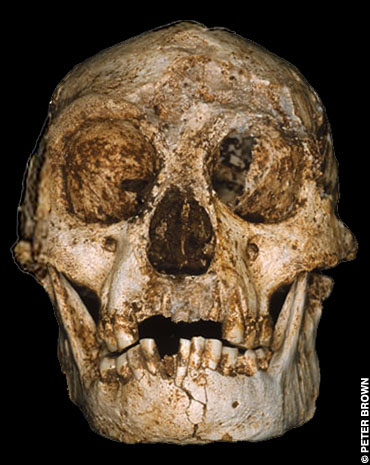
New archaeological discoveries by Australian and Indonesian scientists on the Indonesian island of Flores are revealing that until at least 13,000 to 12,000 years ago and possibly into the nineteenth century, modern humans--our species, Homo sapiens--shared this planet with a totally different species of human being--a three-foot-high dwarf hominid with physical features usually seen as dating from 1.5 to 4 million years ago.


Homo floresiensis skull
(© Peter Brown)


The scientists, mainly from Australia's University of New England and University of Wollongong, have found the skeletal remains of up to seven individuals in a cave at Liang Bua, Flores. Their diminutive stature, small brain size (380 cc), receding chin, the shape of their first mandibular premolar tooth and the skull base design in the ear region are all reminiscent of early Australopithecus, a type of hominid which was thought to have existed only in Africa prior to 3 million years ago.

On the other hand the thickened cranial vault, the relatively flat face, and the smaller molar teeth of what is being called Homo floresiensis are all more reminiscent of Homo erectus, which flourished between 1.8 million and possibly 300,000 years ago.

The newly discovered Flores skeletal material, published this week in the scientific journal Nature, may be from a species which either b

roke away from our distant ancestor Australopithecus some 3 million years ago or more likely a species derived from a very early form of a later ancestor of ours, Homo erectus.

"The skeletal material we have found has come as a big surprise because hominids of that body size and brain size were supposed to have become extinct 3 million years ago," says excavation member Peter Brown, a physical anthropologist from the University of New England.

It is quite possible that the Homo floresiensis' tiny size--and correspondingly small brain--is a result of being stranded on a small island for tens or hundreds of thousands of years. Because species on small islands are shielded from predators living on mainland areas, large size often becomes redundant as an defensive advantage, and they "shrink" evolutionarily over time.
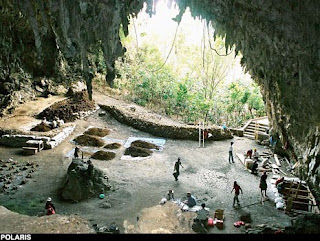
The archaeological evidence strongly suggests that H. floresiensis made sophisticated stone tools, including choppers, cutting blades, scrapers, and even spear points, some of which appear to have been hafted onto lengths of wood. Tools dating to 800,000 years ago have been found on Flores. These tools are very similar to those made by ordinary Stone Age humans (especially in Europe and North America), and yet the Flores hominid had a brain capacity similar--in terms of ratio to body size--to that of early humans like the australopithecines and Homo habilis, who made only very rudimentary stone tools. The only other explanation for the presence of such sophisticated stone tools, which were found together with the skeletal material, is that they were produced by Stone Age H. sapiens--but the earliest of the tools from this site date from 90,000 years ago and H. sapiens is not currently thought to have arrived in Southeast Asia until 50,000 to 60,000 years ago. In 1997, dates on fossils from Ngandong, Indonesia, suggested H. erectus survived as late as 53,000 to 27,000 years ago (see "Homo Erectus Survival").

"All the evidence so far indicates that the stone artifacts prior to 12,000 years ago at Liang Bua were all made by Homo floresiensis" says Mike Morwood, an archaeologist from the University of New England, who has been leading the investigations on Flores.

What's more, folklore evidence, which has been gathered by the researchers on the same island, provides the remarkable suggestion that H. floresiensis may have survived until at least 150 years ago. And zoological evidence from another Indonesian island, Sumatra, suggests that a potentially similar intelligent bipedal species may still be alive and well and living in a remote jungle area.

The local tradition for H. floresiensis is potentially significant. Villagers in Flores say that up until around 150 years ago, there were small, three-foot-tall hairy "people" who used to steal food from them. Known as the ebu gogos (literally "the grandmothers who eat anything"), they were tolerated by islanders until they stole a baby and ate it. Whether the ebu gogo is pure myth or an acc

urate recollection of H. floresiensis is at present unprovable. "The folklore material raises the real possibility that H. floresiensis actually survived until sometime in the nineteenth century," said excavation member Bert Roberts, a geochronologist at the University of Wollongong who conducted interviews with the villagers earlier this month. "Indeed, there has to be a remote possibility that they still survive today in some remote jungle area of the island."


Artist's rendering of the three-foot-high hominid (Peter Schouten/National Geographic Society)


On Flores, there have been no sightings of such creatures--at least, potentially, since the nineteenth century. However, in the same island chain, on the much larger island of Sumatra to the west, there have in recent years been brief, as yet unpublished sightings by a primatologist and others of a small, hairy four-foot-tall ape-like creature known to local tribesmen as orang pendek--literally "little person." Some zoologists suspect that a few hundred of them survive in the remote jungles of the Sumatran interior, but none have yet been captured or examined by scientists.

The new discoveries are likely to be greeted with immense excitement by the international scientific community.

"We now have to entertain the possibility that somewhere within the islands of southeast Asia, early types of human being--long thought to have been extinct--may indeed still survive," says Robert Kruszynski, a leading anthropologist at the Natural History Museum in London.

David Keys is ARCHAEOLOGY's London correspondent.


Article Source :www.archaeology.org

Tuesday, June 7, 2011

Archaeologists believe there are many sites in Lenggong waiting to be discovered

LENGGONG Valley in Upper Perak, where the government is seeking Unesco world heritage site status, is a jewel in Malaysia’s archaeological crown.

Dubbed “an archaeologist’s dream valley”, the undisturbed site has many more discoveries to be unearthed by the local archaeologists in years to come.

How they lived: An exhibit at the Lenggong Archaeology Museum depicting the daily life of prehistoric men at the Gua Teluk Ke lawar.

Commissioner of Heritage Prof Emeritus Datuk Zuraina Majid said a series of important discoveries in the valley had contributed enormously to the nation’s prehistory knowledge.

She said Palaeolithic finds such as Kota Tampan was extremely rare in South-East Asia.

“Kota Tampan stimulated enormous interest in the archaeological world attracting the attention of both academics and the general public,” said Zuraina.

For many years, she had led teams comprising scientists from Universiti Sains Malaysia and various institutions and technical staff from local museums in archaeological work in the Lenggong Valley.

Used daily: Pebble tools found in Gua Teluk Kelawar.

“Our work there was repaid by a number of important discoveries, including the finding of evidence that established the valley was home to the earliest known Malaysian inhabitants, dating back to possibly 200,000 years ago, 160,000 years earlier than previous studies had indicated,” she said.

Excavations between 1987 and 1990 revealed that Kota Tampan was a stone age workshop dating as early as 50,000 years ago.

It was also discovered that there was a stone age community living in the surrounding Lake Cenderoh.

Priz ed: Four-tiered cord-marked pottery found in Gua Harimau.

Several findings had considerable impact on regional and world archaeology.

Among these are the ‘Perak Man’ (the only prehistoric skeleton in the world born with the congenital deformity Brachymesophalangia Type 2) in Gua Gunong Runtuh, Palaeolithic stone tool-making techniques in Kota Tampan, the migratory route of Homo sapiens from Asia to Australia, and the revelation that South-East Asia was not the backwaters of civilizations as claimed by earlier archaeologists.

USM Centre for Archaeological Research Malaysia director Assoc Prof Dr Mokhtar Saidin had recently said hand-axes and evidence of a meteorite impact 1.83 million years ago were discovered at Bukit Bunuh.

He said Bukit Bunuh,would be the oldest prehistoric settlement in the world after Africa according to chronometric dating.

Lenggong Archaeology Museum assistant curator Nur Aidah Pirus said Gua Harimau was another significant archaeological site where 11 Neolithic-Bronze burials were discovered. Pottery, stone tools, bronze, iron, ornaments, hematite and food remains were found together with the skeletons.

Preh ist ori c graves : Replica of Gua Harimau burials at the museum.

The discovery of the bronze and its mould, dated around 4,500 years old, indicated that bronze craftmanship was not confined to the northern part of Thailand (Ban Chiang) alone.

Another site is Gua Kelawar where human habitation is evident since 10,000 years ago. It is located at Bukit Kepala Gajah, a limestone massif which also includes Gua Gunung Runtuh where Perak Man was found.

The Kampung Temelong Paleolithic Site is located about 3km from Lenggong town, and 1km south of Bukit Jawa. Archaeological evidence reveals that Kampung Temelong could be as old as Bukit Jawa which is 300,000 years old.

Negrito charcoal paintings by early orang asli settlers are found on the walls of Gua Badak.


Article Source :The Star Online

Friday, May 27, 2011

Egyptian princess now known to be the first person in human history with diagnosed coronary artery disease

The coronary arteries of Princess Ahmose-Meryet-Amon - as visualised by whole body computerised tomography (CT) scanning - features in two presentations at the International Conference of Non-Invasive Cardiovascular Imaging (ICNC) currently taking place in Amsterdam (15-18 May). ICNC is now one of the world's major scientific event in nuclear cardiology and cardiac CT imaging.


The Egyptian princess Ahmose-Meryet-Amon, who lived in Thebes (Luxor) between 1580 and 1550 BC and who is now known to be first person in human history with diagnosed coronary artery disease, lived on a diet rich in vegetables, fruit and a limited amount of meat from domesticated (but not fattened) animals. Wheat and barley were grown along the banks of the Nile, making bread and beer the dietary staples of this period of ancient Egypt. Tobacco and trans-fats were unknown, and lifestyle was likely to have been active.

Both presentations were based on findings from the Horus study, in which arterial atherosclerosis was investigated in 52 ancient Egyptian mummies. Results have shown that recognisable arteries were present in 44 of the mummies, with an identifiable heart present in 16. Arterial calcification (as a marker of atherosclerosis) was evident at a variety of sites in almost half the mummies scanned, prompting the investigators to note that the condition was common in this group of middle aged or older ancient Egyptians; the 20 mummies with definite atherosclerosis were older (mean 45.years) than those with intact vascular tissue but no atherosclerosis (34.5 years).

Although relatively common at other vascular sites, atherosclerosis in the coronary arteries was evident in only three of the mummies investigated, but was clearly visualised in Princess Ahmose-Meryet-Amon (in whom calcification was present in every vascular bed visualised).

The CT scan image below shows that the princess, who died in her 40s, had atherosclerosis in two of her three main coronary arteries. "Today," said Dr Gregory S Thomas, director of Nuclear Cardiology Education at the University of California, Irvine, USA, and co-principal investigator of the Horus study, "she would have needed by-pass surgery."

Image: Calcification, seen as white, in the right (RCA) and left coronary arteries (LCA), each indicative of coronary artery disease.


"Overall, it was striking how much atherosclerosis we found," said Dr Thomas. "We think of atherosclerosis as a disease of modern lifestyle, but it's clear that it also existed 3500 years ago. Our findings certainly call into question the perception of atherosclerosis as a modern disease."

If, however, the princess enjoyed a diet deemed to be healthy and pursued a lifestyle probably active, how could this "disease of modern life" affect her so visibly? Dr Thomas and his co-principal investigator Dr Adel Allam of Al Azhar University, Cairo, suggest three possibilities.

First, that there is still some unknown risk factor for cardiovascular disease, or at least a missing link in our understanding of it. Dr Allam noted a likely effect of genetic inheritance, pointing out that much of the human predisposition to atherosclerosis could be secondary to their genes. He similarly raised the possibility that an inflammatory response to the frequent parasitic infections common to ancient Egyptians might predispose to coronary disease - in much the same way that immunocompromised HIV cases seem also predisposed to early coronary disease. Nor can a dietary effect be excluded, despite what we know of life in ancient Egypt. Princess Ahmose-Meryet-Amon was from a noble family, her father, Seqenenre Tao II, the last pharaoh of the 17th Dynasty.

So it's likely that her diet was not that of the common Egyptian. As a royal, she would have eaten more luxury foods - more meat, butter and cheese. Moreover, foods were preserved in salt, which may also have had an adverse effect.

Despite the suggestion of a genetic, inflammatory or unknown effect, Drs Thomas and Allam were keen not to discount those risk factors for heart disease which we do know about. Indeed, even in the study's apparent association of atheroma with increasing age, there was a pattern of prevalence consistent with our own epidemiology today. “Recent studies have shown that by not smoking, having a lower blood pressure and a lower cholesterol level, calcification of our arteries is delayed,” said co-investigator Dr Randall C Thompson of the St Luke's Mid-America Heart Institute in Kansas City, USA. “On the other hand, from what we can tell from this study, humans are predisposed to atherosclerosis, so it behoves us to take the proper measures necessary to delay it as long as we can.”

Most of the Horus study research was performed at the National Museum of Antiquities in Cairo and would not have been possible without the availability of non-invasive CT scanning, the focus of the ICNC congress in Amsterdam. CT scanning and nuclear medicine imaging are the cornerstones of modern quantifiable cardiac disease detection, with safe and reproducible results.


Sumber artikel : http://www.escardio.org
Sumber Gambar :http://archaeologynewsnetwork.blogspot.com

Thursday, May 5, 2011

Hari Lestari setiap Isnin

MAJLIS Perwakilan Mahasiswa Universiti Sains Malaysia (MPPUSM) mewujudkan Hari Lestari setiap Isnin sebagai usaha menyuntik kesedaran warga kampus terhadap semangat cintakan bumi.

Yang Dipertua MPPUSM, Muhammad Idzuan Jamal�ludin, berkata usaha itu bertepatan hasrat universiti mewujudkan suasana bersih dan sihat di kampus sekali gus memberi peluang mahasiswa menjalani kehidupan berkualiti.

Menurutnya, sebagai permulaan, semua exco MPPUSM berbasikal ke kuliah dan menjadi contoh kepada mahasiswa lain untuk mengikuti langkah serupa.

“ Usaha ini bukan saja untuk memberi mesej supaya menyayangi bumi juga langkah untuk mengelakkan pencemaran dan kesesakan kampus di samping menjayakan kehidupan sihat di kalangan mahasiswa.


“ Sebagai permulaan, MPPUSM sudah memulakan langkah awal berbasikal ke kuliah dan berharap mereka yang lain mengikutinya. Biarpun tidak diwajibkan, MPPUSM berharap mereka akan menyokong usaha ini.


“ Pada masa sama, langkah pengurangan penggunaan beg plastik di kampus juga akan dilakukan secara berperingkat demi kebaikan semua,” katanya.

Bagi memberi peluang mahasiswa menyuarakan pendapat menggunakan saluran betul, MPPUSM juga dalam perancangan untuk menganjurkan konvensyen pembentukan parlimen mahasiswa peringkat nasional yang dijangka berlangsung bulan depan.http://www.blogger.com/img/blank.gif


“ MPPUSM kini dalam usaha mengumpulkan penyertaan semua institusi pengajian tinggi awam untuk datang ke USM bagi tujuan itu. Melalui kewujudan parlimen mahasiswa ini, mereka ada saluran betul untuk menyalurkan pendapat atau pandangan.


“ Ini juga menjadi bukti pihak berkaitan seperti Kementerian Pengajian Tinggi sangat terbuka dan mahu mendengar pandangan mahasiswa sekali gus membuka peluang mereka bersikap lebih rasional dalam mengambil apa jua tindakan,” katanya.

Sumber : Metro Online
Related Posts Plugin for WordPress, Blogger...
Pulau Kelumpang Dari Perspektif Arkeologi
We’ve said that at campus, learning in class is nothing like you’ve ever experienced before. That’s true. But in campus you’ll also be challenged to learn and grow outside the classroom. We’re are a close-knit community where students do much more than just go to class together. The campus is a hub of activity where anything can happen – a small group late-night study session, a concert in the student-run Cave or an impromptu mud football game. There’s a hometown feel to the place. Everyone is in it together, in the residence hall; on athletic fields, courts and in the stands; on the stage and in the audience for performing arts; and in scores of campus clubs Yes, it’s a special place. It’s a place where students learn, live and laugh. And there will be no end to the things you can do and the friendships you’ll make.